
I spent three days in San Marino, a landlocked microstate completely surrounded by Italy. The people of San Marino are called the “Sammarinese.”
Travelling in Afghanistan is hard, but writing about Afghanistan is easy. If you are a white person in a place like Afghanistan, interesting things will happen to you. You don’t even have to do anything. Just stand on a street corner and strangers will stare at you and walk up to you and introduce themselves and shake your hand and offer you tea and food and show you around the city and you’ll find that it is harder to avoid getting into writing-worthy traveler adventures than to find them.
The European microstates of San Marino, Liechtenstein, Monaco, and Andorra have the opposite dynamic from a travel perspective. They are beautiful, wealthy, safe, lovely countries squarely rooted in one of the most beautiful, wealthy, safe, and lovely regions in the world. Hence, they are some of the most pleasantly boring/boringly pleasant countries in the world. Their populations are content, their governments are highly functional, their economies hum along, and nothing of note has happened in any of them since World War II.
So in a sense, travelling through these European microstates is the ultimate challenge of this blog. Not in the sense of paying that AK-wielding border guard $200 to let me out of Guinea was challenging, but in the sense that I needed to enhance my travel-writing focus to maximally mine pleasant dullness for anything interesting to write about.
I spent three days in San Marino, Liechtenstein, Monaco, and Andorra each, which, considering that they vary in geographic size from an American metro area to a large municipal park, and vary in population size from Bend, Oregon to Watertown, South Dakota, is a lot of time for each. I truly wanted to suck the travel marrow from these countries.
I’m not sure that I entirely succeeded and I’m not sure I’ll write about all of them, but first up is San Marino.
(Note – all images in this post can be expanded by clicking on them.)
Overview:
Population (2026) – 33,500 (5th lowest in the world)
Population Growth Rate (2025) – 0%
Size – 23.6 square miles/61.2 square kilometers (a little bigger than Manhattan)
GDP (nominal, 2025) – $2.25 billion (less than the estimated net worth of Mr. Beast)
GDP growth rate (2025) – 1.5%
GDP per capita nominal (2025) – $65,543 (comparable to Austria or Kentucky)
GDP per capita PPP (2023) – $78,000 (compare to about $59,000 for Italy, or $55-60K for the two adjacent Italian provinces)
Inflation rate (2021-2024) – 1.24-5.93% (Euro)
Biggest export – “Washing and Bottling Machines”
Median age (2025) – 48.6 years
Life expectancy (2025) – 86 years (ranked #2 in the world on some lists)
Murder rate (2025) – 0 per 100,000
Ethnicity – I don’t think there are any official records, but presumably mostly Sammarinese and Italian
Religion (2023) – 85-95% Catholic
Olympic Medals – 3 (1 silver, 2 bronze, all from the 2020 Tokyo Olympics)

Geography
Normally I don’t describe national geographic layouts in these posts, but I think it’s worth doing for the European Microstates to emphasize their tininess and respective geopolitical oddities.
San Marino is situated in a hilly/mountainous region in northern-central Italy, wedged between two Italian provinces (Rimini and Pesaro e Urbino). The nearest significant population center is Rimini (~150,000 inhabitants), a somewhat rundown coastal beach city with typically beautiful Italian old towns and cathedrals. It took two trains over five hours for me to get from Rome to Rimini, from which almost everyone enters San Marino.
The Rimini-San Marino bus runs every hour from morning to night, is surprisingly convenient, and takes about 45 minutes to drop off passengers in the heart of San Marino. Like every other European Microstate (except Andorra), there are no border checkpoints around San Marino.
While waiting for the bus at 10 AM on a Wednesday, two ambiguously accented European men approached me, one of whom was shirtless. I soon learned that they were Bulgarian BMW salesmen on holiday in Italy, and they decided to take a boozy day trip to San Marino. I never learned why the one guy was shirtless, including throughout the entire bus ride, but I guess Bulgarians are going to Bulgarian.
The capital of the nation of San Marino is the City of San Marino, which is situated in the center of the country. The City of San Marino is one of nine castelli (Italian for “castle”), their term for municipalities, or perhaps more accurately in this case, tiny provinces. Castello populations range from 11,200 to 1,000, and the capital is actually only the third-largest at a little over 4,000 inhabitants, largely due to the City of San Marino being given almost entirely over to tourist and government functions (in that order).
Having done almost no research on San Marino before arriving, my first surprise was how rural the country feels. I guess I implicitly assumed that microstates tend to be compact and urban, like Vatican City or Monaco, but most of San Marino feels vast and empty. It’s a land of fairly steep rolling hills with nearly all stores and homes built along primary avenues with few side roads.

Serravalle, the largest castello (holding about one-third of the population), is the relative exception and is the most urban part of the country, at least in a modern sense. It is based on the northern border closest to Rimini, so the San Marino Mall and accompanying wholesalers claim most of the commercial traffic coming from Italy. Many Sammarinese live in Serravalle to make daily commutes for work in Rimini:

Serravalle also has a bunch of middle-class European residential neighborhoods:


Once the bus from Rimini gets through Serravalle, tourists find themselves in remote European hill country…


Peppered with small Sammarinese towns…


Aside from the reasonably good infrastructure, the rest of the country doesn’t feel wealthy by European standards, but there is a quiet pleasantness to it. And in most of this pleasant, remote European hill country, you can see the City of San Marino in all of its glory built atop Monte Titano (the country’s highest peak), particularly the Three Towers, San Marino’s most famous sites:


But what is San Marino? Why is San Marino? How did a nation that is smaller than some data centers and can barely fill a large Chinese apartment block and is surrounded by a multi-time imperial power manage to survive as an independent sovereign state for arguably well over a millennium?

The Little Republic That Could
San Marino claims to be the world’s oldest continuously operating sovereign republic.
Its competition includes the Venetian Republic, which lasted 1,100 years from 697 AD to Napoleon’s conquest in 1797. Of other currently independent republics, Switzerland, or at least the Swiss Canton system, can arguably date back to the 1200s, but it was conquered and rearranged a few times, so it wasn’t continuous. If you want to really stretch definitions and claims, Iceland could argue that its current republican government began in 930 with the Althing (the world’s first parliament) with a few interruptions and long periods of sovereignty loss along the way.
But as far as I can tell, San Marino really is probably the longest-running independent republic in history, though even the most ardent Sammarinese fascist would admit that the nation’s official founding date of 301 is highly suspect.
The founding myth is that a Christian stonecutter named Marinus fled persecution in modern day Croatia to settle in remote central Italy where he could live a simple life of Christian tranquility. At the time, Christianity was a growing minority (maybe 10%) in the Roman Empire and faced periodic waves of persecution; official state tolerance of Christianity wouldn’t be enacted for another decade, and Christianity wouldn’t become the state religion until about 380. Meanwhile, Marinus’ home and church in central Italy became a small Christian community, which was later named “Saint Marinus” after its canonized founder, which was later Italianized into “San Marino.”
There is very little evidence of any of this happening. The story of Marinus is based on a Christian manuscript written at least 600 years later, and there is no evidence on the Church’s side of a canonization of any Marinus (though that isn’t too unusual for the time). The first good evidence of San Marino’s existence is the “Placito Feretrano,” an 885 AD legal ruling from the Church that affirmed the separation of the monastery of San Marino from the lands of the Bishop of Rimini. The document implied that the monastery had existed for some time, but San Marino was probably a part of the Kingdom of Italy, a realm ruled by a relative of Charlemagne. The earliest documented evidence of San Marino operating as an independent sovereign city state dates back to a notary deed from a land sale in 1243 that refers to two Consuls governing San Marino, which is the structure the country retains to this day (though the consuls are now called Captain Regents).
This is fascinating to me. As far as modern scholars are concerned, there was some sort of local political entity in San Marino created at some point in probably a 900-year time span (300-1243), but nobody knows when or how or why or who was involved. Even in the heart of Europe, only about 140 miles from Rome, it is possible for the history of an independent political entity to be lost to the sands of time. Of course, I know that the Dark Ages lost a lot of records and kept even fewer, but still, it sort of blows my mind that there is a contemporary European country and nobody knows how it started.
Records get much better from the 14th century onward. At that time, San Marino consisted of whatever community/monastery was on Mount Titano and a few surrounding towns. In the mid-15th century, San Marino joined a war on the side of Pope Pius II against the Lordship of Rimini and the Pope won; in 1463, for whatever contributions San Marino made, it was rewarded with enough Rimini land to double its size by annexing the Castelli of Fiorentino, Montegiardino, Serravalle, and Faetano, bringing the country to its maximum extent and the borders that it maintains as of 2026.
This era, around the 1300s and 1400s, was the height of political decentralization in Europe, at least post-Roman Empire, particularly in modern Germany and Italy. It’s actually pretty hard to recreate maps of the time, but Europe looked something like this:


But from that point onward, Europe went into a period of consolidation as bigger states ate or merged with smaller ones, including the prominent Italian city states like Venice, Florence, and Genoa, and the Papal States itself, all of which entered into the sort of hyper-competitive international diplomatic/warfare competition that produced Niccolo Machiavelli. The most fascinating part of San Marino’s history is that they managed to get through all the fighting and merging in one piece, let alone as an independent sovereign state.
So how did San Marino do it?
San Marino repeatedly made the right diplomatic deals, was in a unique geopolitical environment that catered to its strengths, was highly adaptable, and got very lucky.
IMO, if there was a secret sauce in the equation, it was paradoxically that San Marino was too meek to be conquered. It was a small, rural, isolated group of villages without any significant economic prospects, and it was intimately tied with its Christian monastery and Christian history. Conquest often wasn’t worth it for larger regional powers due to the reputational repercussions – marching an invading army into poor, little, pious, hyper-Christian San Marino in the heart of Italy was a bad look for stronger states. Later on, San Marino adapted diplomatically by emphasizing non-Christian elements of its culture and history, like its republicanism or conservatism, to similarly get on the right side of potential invaders.
I am going to try to go through the history of attempted and realized invasions/annexations of San Marino to give a sense of how this tiny state kept wiggling out of annexation. By my count, there are 13 such instances:
(Note – Keep in mind that when this sequence starts in 1300 AD, the population of San Marino was probably about 1,500.)

First, around 1300, the Bishop of Montefeltro tried to enforce his longstanding territorial claim on San Marino. The conflict escalated to the point of San Marino raising an army, but the two sides settled on a diplomatic deal in which San Marino would continue to recognize itself as part of Montefeltro’s ecclesiastical diocese (sort of like a Catholic Church province) but would otherwise operate as a politically independent entity. However, the Bishopric retained its claim on San Marino, and in 1320, the Bishop tried to transfer his claim on San Marino to the Malatesta noble family in Rimini, but the deal never went through, probably because the Pope (or his underlings) blocked it.
Second, in the 1350s, the Papal States expanded farther into northern Italy. At that point, San Marino was in an alliance with the Count of Montefeltro against the Papal States. After the Count lost one of their wars, he signed a peace treaty in which Papal troops were given license to put a garrison in San Marino. If that had happened and the Papal States had kept expanding, San Marino likely would have been absorbed into the Papal domain. However, for reasons that are seemingly lost to history, this part of the deal was never enforced and no Papal troops were ever stationed in San Marino.
Third, in 1375, allegedly, Sammarinese citizen Giacomo Pelizzaro conspired to launch some sort of insurrection in San Marino and then hand control of the state to the Bishop of Montefeltro, but Pelizzaro was exposed, arrested, and then executed after a confession.
Fourth, around 1443, San Marino was directly attacked by military forces for the first time in its recorded history. There was a long struggle for regional dominance between the Rimini-based Malatesta family and the Urbino-based Montefeltro family, and San Marino siding with the latter. In or before 1443, the head of the Montefeltro family died, and in the midst of the succession, the Malatestas organized a secret night attack to seize San Marino. There isn’t much of a historical account of the battle, but the Montefeltros warned San Marino at the last moment, and the republic fended off the assault.
Fifth, in 1449, the Malatestas tried to bribe key Sammarinese citizens to launch an internal revolt or coup, but the plot was discovered and fell apart.
Sixth, in 1502, San Marino was militarily occupied for the first time in its recorded history and came closer than ever to being annexed by Cesare Borgia, who was the son of a Pope, the Duke of Romagna, and later one of the later key figures in Machiavelli’s The Prince. In the early 1500s, he went on a remarkably successful military and diplomatic conquest spree in Central Italy. San Marino was aligned with Borgia’s enemies and knew it was in its war path, so it made a bunch of diplomatic overtures and sent gifts (of food and wine), but San Marino couldn’t wriggle its way out of danger; in 1502, Borgia’s troops conquered and occupied San Marino. A few months later, the Sammarinese successfully revolted and reasserted independence, asked Venice for help against a Borgia counterattack, Venice refused, and the Borgias reconquered San Marino. That is until mid-1503 when the Borgia regime suddenly fell apart due to Italian political back-stabbing, and the Borgia troops slinked away and permitted San Marino to become an independent country once again.

Seventh, the near-conquest in 1543 was a strange one. A mercenary army of 500 men attempted a surprise assault on San Marino in the middle of the night, just as the Malatestas had tried exactly 100 years ago. However, there was an allegedly divinely sent fog over the land that night, so the mercenaries were scattered and couldn’t get to San Marino fast enough. When day broke, the mercenaries were discovered, and San Marino called for assistance from the nearby Duke of Urbino who proceeded to run the mercenaries off. It is lost to history who actually hired the mercenaries or why.
(In the 1460s, the Malatestas were finally defeated by an alliance of the Pope and the Montefeltros, and that’s when San Marino doubled its size to its current borders.)

Eighth, in 1549, there is a sparse historical record of the nearby Lord of Verucchio plotting an invasion of San Marino, but when the plan was discovered, San Marino once again asked the Duke of Urbino (of the Montefeltro family) for assistance, and the Duke’s mere pledge of support put an end to the plot.
Ninth, in 1556, pretty much the same thing happened again, but this time the Duke of Urbino scared off the Pope. Why was Urbino so good to San Marino? Because the latter was small, unambitious, loyal, acted as a buffer state against enemies, and by that point, the alliance had been in place for centuries, dating back to when the Montefeltro family didn’t hold Dukedoms.
Tenth, in 1631, San Marino faced arguably the greatest long-term threat to its independence to date when the Dukedom of Urbino was absorbed into the Papal States, which left San Marino as an enclave within the Papal States. With no larger protector, the Papacy certainly had the military power and authority to absorb tiny San Marino. Instead, the Sammarinese went on a diplomatic blitz and got the Pope to sign an update of a 1603 treaty affirming San Marino’s independence. As with the Dukedom of Urbino, San Marino was small, loyal, unambitious, and also Catholic enough for it to not be worth the Papal States making a fuss about its independence.

Eleventh, 1797 was a fun one. From March 1796 to October 1797, Napoleon ran around Italy crushing Austrian/Italian/Papal armies and turning himself into a legend. And when he wasn’t fighting battles, writing condescending letters to the Pope, or stealing art, he was redrawing the map of Italy pretty much entirely by his unilateral whims. Many longstanding city states and dukedoms were demolished or merged into larger polities formed by fiat by Napoleon, including the Republic of Venice, which was brought to the end after 1,100 years of existence when Napoleon abolished its government and soon handed it over to Austria as part of a larger peace deal.
It seemed like tiny San Marino had finally encountered an Italian who could could easily conquer the republic and there was no bigger, stronger state left to defend it. In 1797, when Napoleon sent a diplomat to San Marino, the republic braced for the worst. But unbeknownst to its Captain Regents, San Marino was in a far better diplomatic position than it knew. It had vibes on its side.
Basically, as best as I can tell from the historical record, Napoleon and most other well-read revolutionaries of the time knew of San Marino as a historical curio but almost nothing about its specifics. They didn’t know how its government worked (beyond being a republic) or who ruled it, and they almost certainly never met anyone from San Marino and probably not anyone who had been to San Marino, but nevertheless, they liked San Marino because it was a weird little descendent of the Roman Republic that had survived for centuries despite being nestled between reactionary Popes, kings, and dukes. From the revolutionary standpoint, San Marino had good vibes.
Napoleon’s Life in Camp and Cabinet was published in 1847 and is not exactly the most reliable account of the French Emperor, but its part on San Marino is probably directionally accurate:
“Some hundred and thirty odd miles north of the city of Rome… stands a strong town, built upon a mountain, called San Marino, the capital of a small republic bearing the same name, the territories of which comprise little more than a few barren rocks: in this rude district, during the space of thirteen hundred years, freedom has flourished in all its primitive simplicity. Buonaparte, when he entered the Romagna, caught a glimpse in the distance of this abode of liberty, upon which, at that moment, the sun shed some of its brightest rays; its elevation, thus illumined, afforded a beautiful perspective that appeared to make a deep impression upon the Corsican, when he understood, by inquiring, the character of the scene with which he was so much pleased. It is rather a singular circumstance, that although he would go to Rome to conclude his treaty with the ministers of the Vatican… he was extremely anxious to visit the rugged eminence of San Marino: to show his respect for the independent mountaineers, he wrote to its government, both through his general, Berthier, and by his own hand, in which he says,—
“Citizen Monge [the diplomat Napoleon sent to San Marino] has described to me, citizens, the interesting picture which your little republic presents, and I have given orders that the citizens of San Marino may be exempt from contributions, and respected in whatever part of the French republic they may happen to be. I shall give orders to General Sahuguet, who has his headquarters at Rimini, to transmit to you four pieces of field-cannon, which I present to you in the name of the Republic. He will likewise place at your disposal a thousand quintals of corn, which will serve for the supply of your people until the harvest. I beg you to believe, citizens, that under every circumstance I shall be anxious to give to the people of San Marino proofs of my esteem and distinguished consideration.”
So not only did Napoleon not destroy San Marino or merge it into some puppet Italian state, but Napoleon declared his friendship with the republic and gave it a bunch of food and cannons and praise.
And better yet, a few months later, Napoleon offered land. Or at least Napoleon’s envoy was authorized to discuss San Marino’s potential annexation of eastern land to connect the republic to the Adriatic Sea. At the time, that territory was longstanding Papal State land and quite valuable.
But San Marino wisely declined the lebensraum. Its leadership had become explicitly devoted to the doctrine of keeping San Marino small and weak, and by extension, out of the firing line of more territorially ambitious neighboring Italian states. Plus, nobody knew how long these Napoleonic Italian borders (which Napoleon had no legal authority to create) would last, so it was probably best for San Marino to not piss off its likely future-resurgent neighbors.

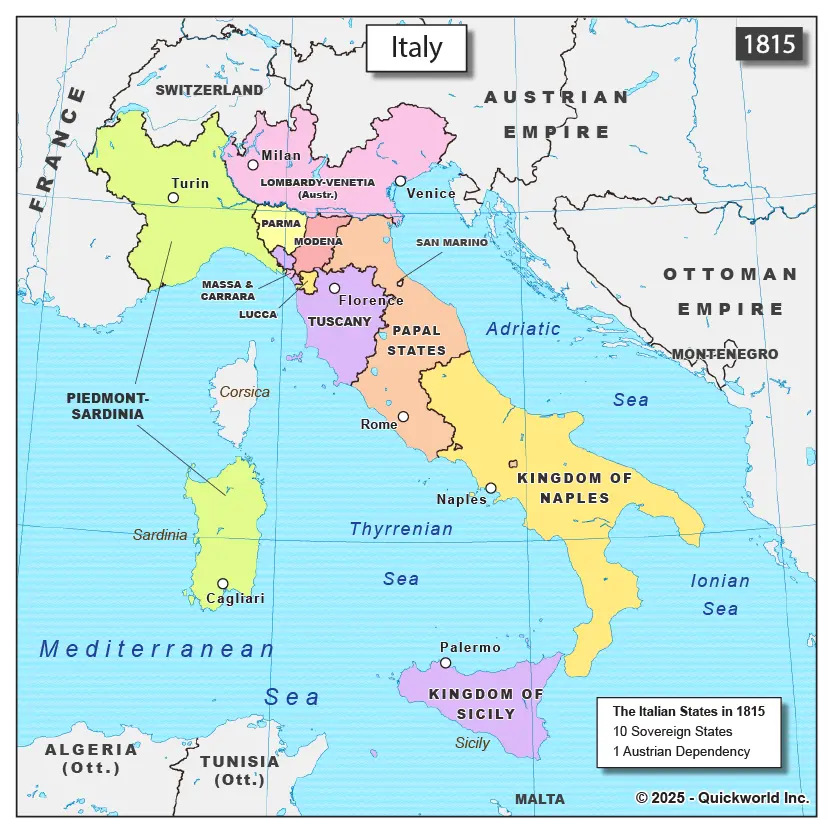
Twelfth, in 1815, after Napoleon was defeated the first time but before he was conclusively defeated the second time, the great European powers got together at the Congress of Vienna to reestablish a balance of powers on the continent. Once again, San Marino was completely at the mercy of foreigners, and also once again, it was completely surrounded territorially by the Papal States, which was in a resurgent position and probably could have bargained for control over the republic. San Marino sent a diplomat to the Congress to argue for the republic’s existence, and while he understandably didn’t do much active negotiating and power-jockeying among the big boys, he more or less acted as a lobbyist for Sammarinese interests.
The result – San Marino was not mentioned in any treaties or pronouncements of the Congress of Vienna, and in this case, no news was good news. The Sammarinese diplomat was apparently able to sell the big powers, particularly the influential Austrians who dominated northern Italy, that though San Marino was a republic, it was an ancient one, and therefore a based and trad defender of Evropean order. As evidence, the diplomat pointed out that San Marino had turned down Napoleon’s offer to let the republic annex more land, a decision that the diplomat himself had strongly recommended 18 years ago.
And so San Marino chugged along as a little independent republic in the new Concert of Europe. But San Marino’s greatest threat to its independence was soon to come. The tiny republic survived the warring Italian families, survived the expansionist Popes, survived Napoleon, and survived the Concert of Europe, but how did an independent Italian state survive the Unification of Italy?

Thirteenth, and finally…
The Italian unification movement got going in earnest during Napoleon’s border redrawings, and grew considerably during the 19th century. After 1815, Italy was divided into numerous independent monarchies, while northern Italy was dominated by Austria and southern Italy was under the control of the French Bourbon dynasty via the Kingdom of the Two Sicilies. Some of the independent Italian states were onboard with pan-Italian unification and plotted to unify while revolutionaries launched revolts in the more conservative states and the Austrian territories. The Sammarinese people and government were broadly sympathetic to the Italian unifiers and sometimes gave refuge to fleeing revolutionaries.
In 1848, there was a wave of liberal revolutions across Europe, including in the Papal States. The Pope instituted some liberal reforms, but they weren’t enough to placate the mob, so in November, the Pope fled Rome for protection in the Two Sicilies. In his absence, liberal Romans pushed out the Papal government and formed a new state awesomely called the Roman Republic. At the military (though not political) head of the revolution was Giuseppe Garibaldi, one of the two main figures of the Italian Unification movement, and the closest thing to a dashing George Washington analogue Italy would get.

Less than five months later, French troops sent by Napoleon III marched on Rome and destroyed the Roman Republic. Garibaldi fled Rome with 5,000 volunteer soldiers for Venice, which was actively fighting Austria. But Austrian forces intercepted and pursued Garibaldi’s army, and after about a month, his forces were whittled down to 1,500-2,000. Feeling the walls closing in, Garibaldi decided to try to hide out with his men in the furtive Republic of San Marino.
Though sympathetic, San Marino was understandably reluctant to let Italy’s most wanted man into its domain with Austrian armies in pursuit. At first, San Marino tried to give Garibaldi’s army some food and send it on its way, but Garibaldi made the case that without being granted asylum, he and his men would all be killed, or imprisoned and then killed. San Marino finally gave Garibaldi and his men access to the republic on the grounds that they effectively disband as an army and hand over all of their weapons, and then allow San Marino’s government to negotiate with Austria for their protection on essentially humanitarian grounds. Garibaldi accepted the terms.
For its part, Austria was surprisingly lenient with San Marino’s blatant diplomatic transgression. It only asked that the republic turn over Garibaldi and his top lieutenants so they could be exiled overseas, and for San Marino to surrender all the Italian weapons it had collected, and then the other 1,500-2,000 Italian rebels could return home unharmed.
When Garibaldi heard these terms, he assumed San Marino would accept them, so he snuck out of the republic with a small group of followers, tried to make his way north to Venice again, but ran into more Austrian forces, and ended up roaming around Italy as a fugitive. Meanwhile, an understandably pissed off Austrian army crossed the Sammarinese border and threatened to occupy the country for collusion with the rebels, but the San Marino government managed to calm things down, hand over the guns, and reaffirm the original terms to let the rest of the rebels return home.
This is, as far as I can tell, the factual recollection of key events. Where history becomes far murkier is what Garibaldi did or who he talked to during his brief time in San Marino, which is estimated at something like 12 hours. Allegedly, Garibaldi was so thankful to San Marino for its protection, so enamored of its people, and fell so utterly in love with the republic during his day trip, that he may have single-handedly saved San Marino’s existence.

In 1861, the Kingdom of Italy was formed. Garibaldi’s official role was only as an elected Deputy (akin to a Member of Parliament), but he was also the heroic, dashing, out-front leader of the now successful Italian revolution, which had just absorbed the states of Tuscany, Parma, Modena, the Kingdom of the Two Sicilies, and most of the Papal States. San Marino congratulated Garibaldi by making him an honorary Sammarinese citizen.
The historical records are shaky here, but there are some accounts that King Victor Emmanuel II and possibly some contingent of Italian revolutionaries wanted Italy to absorb San Marino because… why not? It’s literally surrounded by Italy and filled with Italians.
There is much better evidence that Garibaldi was an outspoken supporter of Sammarinese independence, as he apparently went around revolutionary circles boasting about his Sammarinese citizenship and talking about how great and amazing San Marino was.
And so yet another possibly apocryphal, possibly accurate, and probably at least directionally true claim in Sammarinese history is that Garibaldi used his influence to persuade the other leaders of the Italian Unification movement to leave San Marino alone, thus saving the republic. It’s likely that Garibaldi’s support for the country buttressed the preexisting good arguments for Italy preserving San Marino’s independence as a small, unambitious, deeply Catholic loyal ally that is simply not worth the fuss of invading.
In 1862, the Kingdom of Italy officially signed a treaty with San Marino recognizing its independence and erecting much of the diplomatic and legal framework that exists to this day, which integrates much of San Marino’s economic and legal systems into the Italian sphere, but acknowledges the political sovereignty of the republic in its own borders. And so San Marino lives on.

The fascinating takeaway from San Marino’s history of keeping its independence is that the republic somehow inverted the traditional realpolitik value proposition of being small and weak.
You don’t need to have an Otto von Bismarckian level of diplomatic/historical genius to assert that in general, small and weak countries are absorbed by more powerful neighbors. San Marino seems to be one of the rare historical cases where the opposite was the case. It’s a country that not only got by but actively averted conquest over and over again by asserting its smallness and weakness. Its diplomats, who have an amazing historical track record, repeatedly successfully made the case that San Marino was too insignificant to invade.
How or why did San Marino pull this diplomatic strategy off for at least 700ish years while so many other tiny states were annexed?
Maybe it has something to do with religion? San Marino is (or at least was) a deeply Catholic state that (allegedly) descends from a monastery founded by a saint, and it is located very close to Rome, so maybe it could leverage Catholic piety/literal pity in a way that few other states ever could?
Another lesson is the importance of compounding sovereign legitimacy. The longer San Marino lasted, the more international legitimacy it gained as a sovereign state, and the harder it became for other states to diplomatically/ethically justify conquest. I wonder if there is empirical evidence for some sort of temporal threshold where once a country is independent for long enough, it becomes exponentially more difficult to gain a minimum level of international acceptance for annexation. Evidently, the other Italian city states and small polities never reached this threshold, not even Venice, but San Marino did.
I don’t know, these are just two theories; I’m very open to hearing more.

The Little Republic That Wasn’t
San Marino prides itself on being the world’s longest lasting republic, but for much of its history, it arguably wasn’t.
As with so much of Sammarinese history, the details of its democratic structures are a little vague and some aspects are lost to time. But what is known is that by the late middle ages, the republic’s primary legislative body was the “Arengo,” an assembly of every male household head in the country. Members of the Arengo were elected to Councils to manage particular administrative duties like appointing executive magistrates to run parts of the government.
Over time, the Councils consolidated or were subsumed into a single larger council, which, as far as I can tell, has annoyingly had lots of different names throughout San Marino’s long history, including the Council of Sixty, the Great and General Council, and the Prince and Sovereign Council. Regardless of its name, it usually had around 60 members and eventually settled on 60 members, and for a while it was named after its 60 members, so for the sake of simplicity, I’ll refer to it as the Council of Sixty.
The specific rules for how the Council of Sixty interacted with the Arengo changed over the centuries, but San Marino basically had a republican structure with fairly little democracy but a lot of representative filtering. All male household heads were in the Arengo, and the members of the Arengo elected the members of the Council of Sixty from among themselves, and then the Council of Sixty chose magistrates to conduct executive functions of the state, the most important of whom were the two Captain Regents (modeled after Roman Consuls), who served for six-month terms.

However, throughout the 13th-16th centuries, there was a gradual atrophying of the Arengo. It handed more and more of its power off to the Councils and later the Council of Sixty, which tended to be dominated by the wealthiest Sammarinese families. Slowly, the Arengo met less and less often, until it ceased meeting altogether in 1571. In about 1600, the final nail was put in the Arengo coffin as the Council of Sixty stopped electing new members; when a member died or resigned, the Council voted to choose a new member from the population to take his place. Henceforth, the Council’s power was entirely self-contained and the democratic base of San Marino’s government was broken.
This trajectory has an interesting parallel and divergence from what happened to the Roman Republic (upon which San Marino is partially based). The Roman Senate was technically just an advisory body; it’s role was to advise the magistrates, executive officials elected from the population. For centuries, the informal norms of the Roman state and society ensured that the magistrates followed the Senate’s advice closely, but eventually the magistrates accumulated so much independent wealth and military power that they began to subvert and then ignore the Senate, until Julius Caesar and then Augustus permanently broke the Republic and subjugated the Senate.
San Marino’s republican breakdown took a different form where the primary legislative body’s power was slowly usurped by another legislative body, though a less democratic and more elite one. So in Aristotelian terms, Rome went from a republic to a dictatorship, while San Marino went from a republic to an oligarchy.

With that said, we shouldn’t overstate the oligarchic nature of the post-1600 government too much. ChatGPT estimates San Marino’s population in 1600 at 3,500-4,000, which would divide into about 800 families. So if 60 of those families were represented in the Council of 60, that would mean there was political representation for 7.5% of families. That’s still pretty oligarchic, but the sense of scale is important.
San Marino largely dodged the liberal revolutionary fervor of the 19th century, but in the early 20th century, anti-oligarchic pressure passed a threshold to trigger democratic reform. In 1906, San Marino revived the Arengo for the first time in almost 350 years. Its 805 assembled members were tasked with voting on whether the Sovereign Princely Council (the contemporary name of the Council of Sixty) should maintain its procedure of replacing its own members by appointment or whether new general elections should be held to elect Council members. Out of 802 votes, 727 members of the Arengo voted for the general elections, and to rename the Sovereign Princely Council to the Great and General Council.
Three years later, in 1909, the revolution was completed with a bill passed in the Council that expanded Sammarinese enfranchisement from male household heads to all men over the age of 20. While these democratic reforms were celebrated by many Sammarinese, not all were thrilled by the direction in which the republic was going…


The Little Republic That Could… Generate a Surprising Amount of Political Extremism
I am not a fascist. I swear.
But to the extent that I ideologically and psychologically understand fascism, I get why some Italians, Germans, French, Brits, Spanish, Russians, or even Americans could be fascists. A big part of fascism is harkening back to a nation’s greatness in the traditional masculine sense of civilizational achievements, military conquests, and map-painting. Italy, Germany, France, etc. have such legacies to call back to, but… not all countries do.
I am not saying that San Marino has no historical accomplishments or the Sammarinese have nothing to be proud of. They do! They have run (probably) the longest lasting republic on earth, they apparently produce phenomenal diplomats, and they are one of a handful of tiny nations on earth that have navigated the treacherous waters of realpolitik international diplomatic predation to survive as an independent microstate.
But I still find the entire idea of San Marino fascists funny. This is a country whose existence has depended on not only avoiding war but actively portraying itself as weak to avoid conflict. In my gut, it just doesn’t feel like a country that is conducive to fascism, and its stubborn maintenance of a crossbow militia is not helping.
And yet, San Marino was the second fascist country in the world, and with a 20-year reign, it had the second-longest lasting explicitly fascist regime in history behind the OG Italian Fascist Party.

In 1919, Mussolini founded the Fasci Italiani di Combattimento (“Italian Leagues of Combat”) as the first fascist political movement; in 1921, it transformed into the official fascist party (Partito Nazionale Fascista) as he was elected to Parliament; in October 1922, Mussolini’s followers marched on Rome and he was appointed Prime Minister by the King; by the middle of the decade, Mussolini had assumed dictatorial powers.
Sammarinese fascist development lagged behind Italy, but only by a little. In 1922, about 2.5 months before Mussolini’s march on Rome, the Partito Fascista Sammarinese (PFS) was established. The conditions, organization, and progression of the party followed a very similar trajectory to its fascist cousin in Italy, with seemingly a small but active minority of mostly middle-class citizens banding together for radical authoritarian reform amidst terrible economic conditions and a rising far-left threat (socialists and communists). These middle-class elements aligned with some of the powerful landowning families and presented themselves as a traditionalist defense of Sammarinese values against radical lefty revolutionaries.
It’s easy to forget when thinking about a microstate that it is indeed micro. The 1921 census of San Marino put the population at 12,624 inhabitants. From the figures I can find, the peak of PFS membership was 1,938. So when imagining all this in your head, picture the massive formations, marches, and speeches of Mussolini and the Italian fascists…


…but way smaller. Like a fascist movement for ants.


San Marino’s fascism was aesthetically modeled after Italian fascism and extremely politically dependent upon Mussolini, but it was still homegrown, organic, and had its own Sammarinese ideological structure. Mussolini harkened back to the greatness of the Roman Empire and its imperialistic conquests while Sammarinese fascists harkened back to the alleged true original form of its republic, which was based on traditionalism, agrarianism, temperate rule by the most powerful families, and ancient Latin culture. Once in power, San Marino’s fascists introduced a new calendar that set Year 0 to 301 AD, the alleged founding date of San Marino.
Mussolini’s rise to power in 1922 enflamed PFS momentum, especially after Italian police were stationed in the republic and nearly all of the leftists were chased out of the country or pressured into silence. In January 1923, PFS pressure and anti-leftist repression resulted in the dissolution of the Grand and General Council and the formation of a new legislative body called the Sovereign Princely Council.
Try as I might, I can’t find any substantive differences between the old liberal-leaning council and the new fascist council – they both had 60 members, they both had members elected by male adult suffrage, and they both appointed magistrate executives. The only actual difference seems to be aesthetic; it was the same legislative body, but with a restoration of its old pre-1906 name. Perhaps the fascists looked at the 1906 transition from a cool name like the “Sovereign Princely Council” to a lame name like the “Great and General Council” as the woke bullshit of early 20th century San Marino.
Anyway, in the Sovereign Princely Council’s inaugural election, the only candidates were from a single coalition bloc consisting entirely of PFS fascists and religious conservative allies. This swept the PFS into power and they spent the next few years consolidating authority. In 1926, laws were passed to restrict enfranchisement to male household heads, college graduates, militia members, and men who paid sufficiently high taxes. Soon after, another election was held, and out of 2,445 votes, 2,444 were for the PFS and one vote was invalid. The fascists then consolidated their gains by revoking the 1909 democratic reform, thereby reducing suffrage back to only male household heads.
Interestingly, Sammarinese fascism really was republican; it kept holding elections (albeit with lots of informal repression) and seems to be the only fascist country without a central duce/fuhrer-type figure. The closest equivalent was Giuliano Gozi, who, to be fair, looked like a duce/fuhrer-type figure:


Gozi was from one of the long-standing powerful Sammarinese families. After going to a university in Italy, he was one of about 20ish Sammarinese who volunteered to serve in the Italian army during WWI, where he earned the Bronze Medal of Military Valor. I initially assumed that made him the most decorated Sammarinese in the war, but I later found out that another Sammarinese soldier earned the Silver Medal of Military Valor, so I guess this tiny diplomatically crafty country can also produce some military bad asses.
Regardless, Gozi’s mere Bronze award apparently made him a super star in San Marino, and in 1918, at the age of 23, he was appointed the nation’s Secretary of State for Foreign Affairs. In 1922, he was one of the co-founders of the PFS, and in the following year, he helped organize the restructuring of the government and the ascension of the fascists to power.
Throughout the 20 year dominance of San Marino by the PFS, Gozi remained as the head of the party, held the office of Secretary of State for Foreign Affairs, and was elected Captain Regent five times (non-consecutively). In 1939, Gozi legally gave himself the title of “Count,” which is a pretty low noble title (below marquis, duke, king, and emperor, but above viscount and baron), but still quite audacious for the Secretary of State for Foreign Affairs of a republican government.
I can’t find a ton of info about Gozi online, but this random Italian history website describes him as “an awkward figure and, in some respects, even embarrassing due to his detached and authoritative air of being the best in the class; he was so self-confident as to inspire intimidation and was extremely strict, especially with those who wasted his time or, even worse, those who dared ask for favors. His prickly reserve was often mistaken for ‘snobbishness,’ and for this reason, too, he was not liked by everyone.” Allegedly, Mussolini took a shine to Gozi and tried to recruit him for an administrative post in Rome, but Gozi refused.

What was life like in fascist San Marino? Compared to fascist Italy or Nazi Germany, not too much changed day-to-day in the republic since the fascists weren’t gearing up the country for giant wars of conquest. Though like their fascist brethren, the PFS was obsessed with aesthetics, all the way down to the postage stamps:


Policy-wise, not a whole lot changed internally in San Marino, but externally, the Sammarinese fascists made San Marino closely aligned with its giant, imperialistic, fascist, hulking Italian neighbor that completely surrounded its borders. The PFS welcomed any and all assistance Mussolini was willing to provide and added its small voice to support Italy’s increasingly volatile international policy. In return, San Marino got foreign aid for infrastructure projects, like roads, bridges, schools, etc., including what was legitimately the greatest accomplishment of the Sammarinese fascists – the construction of the Rimini–San Marino railway.

In a weird way, the PFS was indeed harkening back to the greatness of its Sammarinese ancestors. San Marino survived through diplomacy, particularly by placating and pledging strong allegiance to larger, far more powerful neighbors who could protect the republic from other larger, far more powerful neighbors. The PFS was doing the same thing, but instead of embracing a pious, humble, Catholic image, it embraced fascism. It’s not too difficult to imagine a left-wing or even liberal San Marino being bullied or possibly invaded by Mussolini’s Italy. I guess what I’m saying is that Sammarinese fascism sort of worked, or at least it got the republic peace and a train.
That is until June 1940, when Italy entered World War II by declaring war on Britain and France. San Marino remained officially neutral but strongly aligned with Italy, to the point of ramping up the internal fascism. In 1942, the republic adopted Law No. 33, which was inspired by Italian law, which was inspired by German law, and which prohibited marriages between allegedly Aryan natural-born Sammarinese citizens and non-Aryans. I cannot imagine this was enforced much, or even if there was the opportunity to enforce it on a population of 13,000 nearly pure ethnic Italians, but it still stood on the books.
On July 10, 1943, Allied forces invaded Sicily. The Italian fascist regime had long-since lost popular support with how badly the war was going, and in the early morning of July 25, Mussolini was forced to resign by his Fascist Grand Council, and King Emmanuel III resumed executive control over Italy. Mussolini was arrested and imprisoned in a remote hotel in the Apennine Mountains.
Without Mussolini’s backing, the Sammarinese fascist regime lasted three days. On July 28, a crowd protested in the streets of San Marino (the capital) and the PFS government resigned. A moderate leftist government took its place under a new 20-man provisional council called the Council of State while deeper government restructuring was considered. Gozi, the most prominent fascist leader, wasn’t dragged through the streets, but peacefully left power and became a private citizen in the republic.
All might have been well for a non-fascist San Marino, but then the tiny republic underwent Italian fascist whiplash. On September 8, the reempowered Italian king announced an armistice with the Allies, which prompted Nazi Germany to occupy Italy down to south of Rome. On September 12, a German combined arms effort of ground troops, tanks, and paratroopers rescued Mussolini from captivity and he was quickly made the head of the Italian Social Republic, a nominal German puppet state that administered German-occupied northern Italy.

So once again, San Marino was surrounded by a much stronger fascist state, and now one militarily occupied by the worst fascist state in the world, albeit while extremely distracted by more pressing affairs than whatever was going on in a tiny country with a sub-15,000 population.
So during the 20th century up to this point, San Marino was a liberalish republic, but then the much more powerful state around it became fascist, so San Marino became fascist a few months later, but then the more powerful state’s fascist government was overthrown, so San Marino overthrew its fascist government three days later, but then the more powerful state (or at least the half surrounding it) became fascist again two months later, so what did San Marino do?
It became fascist again. At least a little bit.
In October 1943, the ousted Giuliano Gozi approached the 20-man Council of State with a proposal known as the “Citizen Pacification Pact.” Primarily due to concerns of being invaded by Italy and/or Germany, the Council accepted, and five council members were replaced by members of the newly formed Fascio Repubblicano di San Marino (Republican Fascists of San Marino), Gozi’s revived fascist party. And so San Marino became at least partially fascist again.
Regardless, the war inevitably spilled into San Marino. The republic began taking in Italian refugees, including the scant remaining Jews, fleeing the fighting nearby. By mid-1944, the Republic of San Marino, which by that point had a population of 13,000-15,000, was holding an estimated 100,000 refugees stuffed into every available home and building in the nation, with the 17 railway tunnels stretching across 12.5 miles becoming the primary refugee camps. This put the tiny republic under massive resource strain, and Sammarinese emigrants, particularly from the United States, shipped in supplies to keep the people fed. At one point, according to a modern Sammarinese government document, government food rationing was brought down to 50 grams of bread per person per day.
In June 1944, while the Allies were invading Normandy, the British Royal Air Force bombed San Marino’s railway on bad intel that German troops were using it, resulting in the deaths of 37 Sammarinese and 26 refugees. Later, in 1961, the British government paid the government of San Marino £80,000 in recompense for the bombing, but refused to admit guilt.
In August 1944, Gozi met with Mussolini in-person for the last time to ask Il Duce to ask Hitler to not invade San Marino; Mussolini reportedly told Gozi, “You will be surrounded by flames, but you will not be burned.” Supposedly, Mussolini did indeed bring the subject up to Hitler or some sort of German diplomat, but the German response is unknown, and it is doubtful that Hitler gave the slightest shit about San Marino given that his 1,000 Year Reich was collapsing.
In September 1944, the Germans finally invaded San Marino, though not with any declaration of war or intent to conquer, but merely as a strategic positioning of a few hundred to over a thousand soldiers as part of the ongoing fighting against the Allies near the “Gothic Line,” a German defensive line that happened to be run just south of San Marino. The Sammarinese government protested about its neutrality being violated but the Germans didn’t care and took over as many houses as they needed. This prompted the three-day Battle of San Marino wherein British (mostly Indian) troops fought their way into the country and liberated the capital itself. Casualties were in the few hundreds on both sides, and while Sammarinese/refugee casualties are unknown, the Fascist Italian-built San Marino Railway was destroyed by retreating Germans. What comes from fascists is just as easily taken away by them.

Two months after San Marino’s liberation, the restored Great and General Council passed an epurazione, or purge law. Current and former official members of the Fascio Repubblicano di San Marino and a few collaborators were thrown out of their government posts and lost most or all of their government benefits (mostly pensions).
Giuliano Gozi was sentenced to seven years in prison, his brother got five years, and other lieutenants got lesser sentences, with a total of 50 convictions. After about six months in prison, Gozi’s sentence was commuted to exile, so he moved to Rome, did some work with the Vatican, and then moved back to San Marino in 1952, and died peacefully in his home country in 1955.
So as far as post-World War II purges go, San Marino’s epurazione was about as soft as they came. From contemporary sources, this light backlash was partially a result of an unofficial clemency granted to the roughly 2,000 direct members of the old Partito Fascista Sammarinese (PFS); everyone agreed to let the first fascist regime go as a stupid mistake, and focus the purging on the second revived partial fascist regime, which seemed like a more grave error given the revelations and failures of fascism by the mid-1940s. Also, I’d speculate that the lightness of the purge can be attributed to the generally peaceful nature of Sammarinese culture and people.
But why did a purge, albeit a light one, happen at all? Weren’t Gozi and the fascists still in the government in 1944? How and why were the fascists so quickly disposed of?
The answer of course is…


There is something fascinating about the idea that the microstate of San Marino, with a population consisting of fewer than 15,000 rural Italians, went through the same exact radical lurching between far-right and far-left as nearly every other European country in the early 20th century.
Like Germany, Poland, France, Italy, etc., San Marino had both fascists and communists vying for power in the 1920s, with the Italian communist party establishing a Sammarinese outpost in San Marino in 1921. But Gozi and the fascists beat the communists by getting more supporters (particularly wealthy ones) and Italian assistance, so most of the commies fled San Marino or went underground, until they slowly crept back during the 1940s as returning emigres or refugees. In July 1941, the San Marino communist party was covertly reestablished by Ermenegildo Gasperoni, a veteran of the Spanish Civil War. The communists joined with socialist allies to form a secret political coalition called the Committee of Freedom (COF).
By late 1944, the COF had accumulated enough power against the disgraced fascists to launch the purge. In March 1945, San Marino had its first proper post-war election, and the conservatives who had dominated the republic for most of its history were in trouble. Their one-time fascist allies had been purged, their association with fascism had tainted them, and the left had momentum. Worst of all for the conservatives, the 1909 law was fully reinstated for the election, so all adult males could vote, rather than just male household heads. Thus, the COF won 2/3rds of the vote against the conservative opposition, resulting in a ruling coalition consisting of four moderates, 18 socialists, and 18 communists.
This made San Marino the first country on earth to legitimately democratically elect communists to power.

On the one hand, perhaps there was a logic to a communist San Marino. One of the classic defenses of communism is that it works best in small groups where high levels of trust and low levels of inequality can ameliorate the inherent deficiencies in collective organization. In that sense, San Marino is maybe the best possible national testing ground for a communist society.
On the other hand, semi-embracing communism put San Marino in a very bad and unprecedented diplomatic situation. San Marino was a historic master of defensive diplomacy that survived for centuries (almost millennia!) by adapting its government to suck up to more powerful neighbors for protection. When its more powerful neighbors were the Pope and Italian states, then San Marino was extra Catholic; when its more powerful neighbor was Napoleonic France, then San Marino was a bastion of republican liberty; when its most powerful neighbor was Metternich’s Concert of Europe, then San Marino was an ancient keeper of European tradition; and when San Marino’s more powerful neighbor was fascist Italy, then San Marino was fascist (X2).
But suddenly this time-tested diplomatic strategy was inverted. San Marino was the sole semi-communist country in the Western bloc during the Cold War. By the late 1940s, in terms of international relations, San Marino may very well have been better off under fascism than communism. We now know from modern records that the American CIA supported the Sammarinese conservative opposition with funding and guidance, though that didn’t stop the COF from winning more elections, albeit more narrowly, in 1949, 1951, and 1955.


More significantly, leftist San Marino had to deal with Italy, which had come under a moderate Catholic government and was not happy about the commie microstate within its borders. And unfortunately for the republic, Italy knew how to hit San Marino where it hurt – in the canone doganale.
I think there are good arguments for creating more microstates, but one of the arguments against microstates is that they create natural opportunities for tax and regulatory arbitrage that undermines larger states. In this case, Italy had sales taxes on goods like tobacco, matches, and salt, and the government was understandably concerned that Italians would walk across the unguarded, unregulated border into San Marino to buy all the tobacco, matches, and salt their hearts desired and then walk back across the border into Italy without ever paying taxes to the Italian government.
And so in 1862, the newly formed Kingdom of Italy signed the canone doganale agreement with San Marino, wherein the republic would maintain most tax and regulatory parity in exchange for an annual state subsidy, and a huge one from San Marino’s perspective. The original 1862 subsidy was for over 50% of the republic’s pre-1862 annual state revenue. This proportion roughly averaged at the same level for the next 80 years without interruption until Mussolini’s regime fell.
In January 1946, the canone doganale was renewed at 15 million Italian lire, which again reached about 50% of San Marino’s annual state revenue. But starting in 1948, due to the breakdown in relations with the semi-commie Sammarinese government, Italy began withholding its payment for five years, including a retroactive increase in payments for 1946-1947. This put a massive hole in San Marino’s finances; in 1949, San Marino projected that it would be running a 33% budget deficit in the following year. By San Marino’s calculations, by 1951, Italy would owe the republic 660 million lire; San Marino’s state budget that year was about 250 million lire.
Faced with dire financial conditions, humble San Marino, then ruled by a coalition of anti-Western communists and socialists, responded in a manner that no one could have predicted…

In August 1949, San Marino’s first casino opened. Prior, gambling was illegal in the country, but the Council quickly legalized gambling for non-citizens. The casino and a handful of new high-end hotels, which were explicitly modeled after Monaco’s Monte Carlo, were funded by Italian business interests to the tune of 800 million lire, including a 100 million lire upfront payment to the Sammarinese government and a guarantee of 50% of gross revenue to the government for its first three years of operations. Projections estimated that the gross revenue earnings alone would bring the San Marino government 1 million lire per day. At the time, San Marino was negotiating for the canone doganale to be set to 90 million lire annually.
There was an undeniable beauty to this casino gambit. The whole point of the canone doganale was to stop San Marino from taking advantage of its sovereignty to undermine Italian economic priorities for national profit. For generations, a fair bargain was struck to the benefit of both sides, but when Italy tried to fuck the republic out of its due tribute/danegeld, San Marino turned around and gut-punched Italy with the ultimate microstate weapon of mass destruction. At a time when Italy had only four legal casinos (the closest of which was in Venice), San Marino opened up its own casino to soak up loose Italian lire and women, and corrupt the great Latin heartland with loose morals.
Having read through a bit of Sammarinese history by this point, this may well be the single strangest event in the country’s history. The Sammarinese people and culture were known for agrarianism, conservatism, and Catholicism, but suddenly they embraced gambling and debauchery. The Sammarinese state was famous for diplomatic appeasement and alignment, but suddenly it spat in the face of its far more powerful neighbor. Communists are famous for… everything communists do and believe, but suddenly the Sammarinese commies were ready to cash in on the most ruthlessly capitalist trade imaginable. It was like everyone in the late 1940s Sammarinese government had read the “Art of the Deal.”
This is another good spot to pause and remind ourselves how small San Marino is/was, not just in terms of population, but finances. That 1 million lire per day estimated revenue from the casino to the Sammarinese government came out to… $1,600. Or in today’s money, about $22,000 per day, or a little over $8 million annually.

(This is what the casino looks like today, it has been used as a convention center for decades. I saw this building but didn’t know what it was and didn’t think anything of it, so I didn’t take a picture of it; this one is from a Sammarinese blog I found.)
Italy was not happy with this anomalous break in arguably almost two millennia of copacetic relations with tiny San Marino. But it had a way to fight back. If the Sammarinese government had been reading Trumpian literature, then the Italian government had been watching “The Sopranos.”
Within months of the casino opening, the Italian Interior Minister, “who [disliked] both Communists and gamblers” ordered the Italian police to set up check points on all the roads around San Marino. The police checked every car going into the country for drugs and contraband, often demanding that owners take off their cars’ tires and dismantle their engines. The searches were so thorough that motorists could be stuck for 8-10 hours before they were permitted into the republic. As the Interior Minister explained to the press:
“San Marino is an independent state and consequently can act as it likes in its own territory. However, San Marino only occupies the top floor of a big building [and] the staircase leads through other people’s property. If the people on the top floor misbehave and disturb the quiet of other tenants, it is the right of the owner of the building to shut the door.”
San Marino responded by… doing nothing. There was nothing it could do. The San Marino casino made bank for a few weeks, then hobbled on for months with the vanishingly few degenerates willing to breach the Italian police blockade, and then in August 1951, the Sammarinese government shut the casino down since it was costing too much money and bringing almost no revenue in. It was a total Italian victory.
There’s a short but fun August 1951 Time magazine article about the whole affair, called “San Marino: Losing Gamble.” Some choice quotes:
“The Communists piously forbade San Marinese themselves to enter the casino, relied upon a steady stream of wealthy, land-owning Italians and foreign tourists. Said San Marino’s parish priest resignedly: “At first the parishioners thought the casino a scandal. Then they got used to it, for the price of furnished rooms began to rise considerably. There is hardly a family which does not have a croupier as a paying guest at 20 to 25,000 lire a month. My parishioners live up to the motto: ‘Since you eat, why shouldn’t I? Therefore let’s all eat in the name of the Lord.’”
“The Roman Catholic bishops of Rimini and Montefeltro (San Marino is almost due east of Florence) called the casino a sink of iniquity. Italy’s Demo-Christian government discovered that San Marino had become a haven for Italian tax dodgers and quick divorces.”
“San Marino’s casino, its hotels and movie houses stood empty. The gamblers from Genoa stopped paying their rake-off to the government. The government had to borrow money to pay its employees, soon was issuing I.O.U.s instead of wages. Three hundred San Marinese applied for immigration visas to the U.S. Then the Communist government quit. Condemning the Communists’ “stupid and egotistic policy,” the legislature called for a new election, last week set up a bipartisan regency council to talk terms with Italy. Italy wouldn’t budge.”
But it wasn’t a total loss for humble San Marino. In 1953, the republic and Italy signed a new canone doganale agreement: San Marino got 90 million lire per year retroactively for 1946-1952, and got 150 million lire annually thereafter. I can’t find details for why Italy gave San Marino such a sweet deal, but maybe the Sammarinese diplomats worked their magic once again.

Aside from tolerating casinos and renting out rooms to croupiers, what was life like in semi-communist San Marino?
Not too different from the rest of the European social democracies. The landmark reform was a 1950 law that established near-universal healthcare, universal social security, mandatory financial assistance for the very poor, and subsidies for children who couldn’t afford schooling. Prior, San Marino had mutual aid societies and church groups, but now it had an entire welfare state, though the programs didn’t pay out anything until 1956, after the Sammarinese government sorted out its finances by getting back on the Italian dole.
A noted and kind of funny failure of the semi-communist government was women’s suffrage. As a very Catholic, very traditional European state, San Marino had always been restrictive with women, with most of their legal rights being subordinated to their fathers and then their husbands. The Sammarinese communists and socialists were ideologically supportive of expanding women’s rights, particularly enfranchisement, and they eagerly discussed women’s rights reforms after coming to power in 1945. But they quickly ran into an issue – unlike every other communist country on earth, this one was democratic.
It turned out that most Sammarinese women were conservative. This became more apparent in the late 1940s and early 50s when they organized around the Christian Democrat party and began marching in the streets to call for women’s suffrage. This put the leftist government in an awkward position… it ideologically supported women’s rights, but if they enfranchised women, they’d probably be voted out of power by the new conservative majority, especially since the leftist coalition kept winning elections by smaller and smaller margins.
In 1953, the Sammarinese government passed a marginal but progressive law to permit unmarried women to gain or sell property outside of their dowries, but the communist/socialist government dragged its feet on the far more important issue of women’s suffrage for over a decade. Publicly, the COF excused its maintenance of the patriarchy by accusing the Catholic Church and its priests of brainwashing Sammarinese women into conservatism (insert some sort of joke about Hillary Clinton accusing men of forcing women to vote for Trump).

Ultimately, it wasn’t women who destroyed the semi-communist regime of San Marino, but the classic foil of all leftist groups – infighting over relatively trivial affairs that evolves into grandstanding and procedural warfare in blatant bad faith that drives the group into literal civil war.
Despite being geographically within the Western sphere, San Marino cultivated diplomatic and economic connections with the Eastern Bloc, particularly Communist Hungary. In November 1956, Soviet troops stormed into Hungary and crushed a popular anti-communist uprising, killing thousands and exiling hundreds of thousands in a blatant display of authoritarian brutality.
While the crushing of the Hungarian uprising was a big deal in the Cold War, it didn’t have that much effect on San Marino itself. Neither Hungary nor any Eastern Bloc state was anywhere near as critical economically or diplomatically to San Marino as Italy or the US. Regardless, back in San Marino, the communists and most of the socialists stayed loyal to the Soviet-backed Hungarian communist state, but five of the socialist Council members split off in protest and formed a rival leftist party.
After these break-aways, the ruling coalition in the Great and General Council was left with 30 out of 60 seats, while the splinter leftists and conservatives combined to hold the other 30 seats. This state of being perfectly balanced, as everything should be, ended in September 1957 when a final defection officially put the ruling coalition in a 29-31 minority, and right before the Captain Regent elections at that.
What happened next was very confusing. The ruling coalition, which now only officially numbered 29 out of 60 members of the Council, announced the resignations of 34 members of the Great and General Council – the 29 current coalition members + five of the defectors. But… the five defectors said they weren’t resigning. But the ruling coalition said they were, and they had signed resignation letters to prove it. And that meant that 34 out of the 60 Council seats were vacated, and that meant that the Council legally did not have a quorum and could not function, and that meant that new elections would have to be called.
Huh?
Apparently, back in 1955, the leaders of the communist/socialist ruling coalition had forced all candidates on their slate to sign preemptive open-ended resignation letters out of some sort of loyalty test. And now that the ruling coalition had been hit by defections and lost its Council majority, it was invoking the resignation letters on behalf of its defectors in an attempt to make them resign against their wills. I would expect a political maneuver this stupid out of Guyana or some malformed African democracy, but I didn’t expect it out of friendly little San Marino.

The new majority coalition, including the five defectors, did not fall for this political wizardry. Instead, they accused the other side of trying to launch a procedural coup, and formed an entirely new governing entity called the Executive Committee that claimed legitimacy as the ruling body of San Marino.
No physical confrontation took place, but the status quo coalition made sure to station loyal police and military personnel in and around San Marino’s central government buildings in its capital. For the sake of safety and avoiding an outright civil war, the Executive Committee decamped to a tiny town on the outskirts of the country called Rovereta, where they set up their new government in an abandoned industrial building. The Executive Committee’s regime soon colloquially became known as the “government of the shed.”
Over the course of less than two weeks, both Sammarinese governments raised their own militias in preparation for an actual civil war. Within days, Italy declared that it recognized the Rovereta regime as legitimate and surrounded San Marino with police + military personnel.
On October 11, the semi-communist regime surrendered. Italy never actually threatened to invade, but the implication was enough to force capitulation. On October 14, the Rovereta government entered the capital, and on October 23, it reconvened the Great and General Council with 31 members. The new regime, a socialist-Christian Democrat coalition, elected two new Captain Regents and effectively ended San Marino’s 12 years of semi-communism. While there was a short-term armistice between the two sides, the new regime launched anti-communist purges in the government over the following years, including arresting 27 old regime members in 1959. However, the Sammarinese communist party continued operating, and legally at that, even managing to snag 16 out of 60 seats in the 1959 election.
So as far as domestic strife goes, the 1957 affair wasn’t too bad, and neither was the political aftermath. The new Christian Democrat-led coalition was immediately embraced by Italy, diplomatically detached from the USSR, and offered American financial assistance. The new regime proceeded to dismantle some of the labor policies of the old regime, but kept the welfare state intact and even expanded government pensions to farmers. And to get with the times and solidify its electoral position, the regime gave women the right to vote in 1960.

Since the 1960s, San Marino has largely been led by moderate parties. The standard ruling coalitions have been small “c” conservative, but with ample support for the welfare state, strong relations with Italy, and some attempts to play the microstate game with regulatory/tax arbitrage, but nothing that would rock the boat too much. The communist-socialist coalition retook power from 1978 to 1986, but it had firmly detached from Moscow by then and there was no farm collectivization or killing landowners or any of that stuff.
As of mid-2026, the republic actually has quite a few modern progressive representational achievements, albeit largely due to its practice of electing two heads-of-state twice per year. San Marino has had the most female heads-of-state of any continuous state on earth, with 22 women serving 26 terms. In 2007, San Marino elected paraplegic Mirko Tomassoni as Captain Regent. And in 2022, Paolo Rondelli was elected as one of San Marino’s Captain Regents, making him the world’s first openly gay head of state. Hopefully this stuff buys San Marino some progressive points back after the whole fascist thing.

On the Ground
What’s it like to travel through the Republic of San Marino?
When I close my eyes and think of San Marino, I picture four distinct parts of the country.
First, there’s the Castello of Serravalle, the northeastern area on the border closest to Rimini, Italy. This is by far the most populated and commercially active part, and it’s also probably the boringest part since it looks like a generic Italian commercial area with some suburbs and office buildings thrown in:


Second, there are the regions leading from the northeast to the capital in the center of the country, which in its own strange, hard to describe, and kind of boring way, might be the most unique part of San Marino.
My best attempt to explain it is that this region feels like an odd mixture of a bunch of light suburbs and strip malls built along winding hill highways. While there are often pleasant Italian countryside views, the lack of flat land and subsequent lack of building clustering gives everything an isolated feeling. Occasionally, there are small groupings of buildings that feel a bit like a town, but since most of the roads are wide, busy, difficult-to-cross highways, the whole region gives the feeling of roadside truck stops and strip malls. Try to see what I mean:


Though there are some occasional suburbanish areas:


Third, there’s the capital itself, which is also called San Marino. This is the most touristy spot in the country by a huge margin, and for good reason. It’s a legitimately beautiful and occasionally stunning mountain outcrop right in the middle of the republic that can be seen from almost anywhere in the country, particularly its signature Three Towers:

Which, up close, look like:


Behind the towers is a hilltop area that holds a classic European old town:


Down the hill from the old town is the residential area of the capital which is practically deserted:


Fourth, there’s everything else in San Marino, which looks like almost any other especially hilly Italian countryside. Not that there’s anything wrong with that. I thoroughly enjoyed three full days of walking around this:


San Marino Was Not Made for Walking
My goal on this European Microstate trip was to truly see as much of these four tiny countries as possible in three days each. I like to walk when I travel, so this would inevitably involve lots of walking, and here is where I walked in San Marino:

Note that this doesn’t perfectly capture my walking paths because I walked down lots of random side streets and paths and I can’t remember them all.
Also note that this doesn’t perfectly capture my walking paths because I was more meandering. When I do travel walking like this, I stop for coffee in cafes, I go into stores and churches, I stop for lunch or snacks, I sit on benches and watch people, jut into woods or fields for a bit, etc. It’s a soaking process.
My three paths were not based on any established tourism routes. I roughly sketched them out ahead of time based on hitting a few key landmarks and following larger roads on my Google Maps.
What I didn’t realize until I woke up at 6 AM on Day 1 and began walking for 15 minutes is that San Marino is not made for walking. In fact, it’s among the most hostile-to-walking countries I’ve been to.
Of course, it’s easy to walk around the capital where all the tourists go, but not most of the rest of the country. It’s a land of hilly highways, most of which don’t have sidewalks, thereby often requiring me to walk through woods or farmland adjacent to the road. But sometimes the roads are wedged between, say, a rock wall and a cliff’s edge, and there was absolutely no room for pedestrians at all, and so I had to walk very slowly in the road and pray that the nice Sammarinese drivers wouldn’t swing around the sharp turns too quickly and hit me. Other times, there would be no way to safely walk along a highway on one side of the road for hundreds of yards, so to get to a wooded or farm zone on the other side of the road, I would have to frogger across fairly crowded highways.

I will generally walk anywhere when I travel, but there were two instances in San Marino when I had to turn back from my planned routes because I determined that there was literally no safe way for me to walk along a road without taking a huge risk of getting hit by a car or tumbling off a cliff.
I mean, I don’t want to exaggerate this stuff too much. The vast majority of San Marino is sparsely populated and traveled, and though the roads tend to be wide and people drive fast, there is little traffic (vehicular or pedestrian) outside the capital-to-Rimini border area, so it wasn’t like crossing the street in Kabul or whatever. But I want to emphasize that for a pleasantly boring country consisting of idyllic Italian countryside, it was surprisingly difficult simply to walk around San Marino.

My Novel Maximum Touristification Saturation Proxy
By my estimates, 99.9% of tourists who come to San Marino spend 99.9% of their waking tourist hours in the capital. It is a classic European-style old town, and I love a good European-style old town. I spent most of my first day in San Marino going to each of the Three Towers getting some of the best views in the country…

And then crisscrossing through the old town streets…

This is one of the things that makes Europe the undisputed best tourist continent in the world. America has some great cities, but there is nothing like European old towns anywhere in the States, let alone the 100 bajillion European old towns that pepper cities large and small throughout Europa.
On the other hand, San Marino’s old town reminded me of the classic tourist/traveller debates about when a city/site/place becomes overly or thoroughly touristed and ceases feeling authentic. In the above pictures, I would estimate that 99.9% of those people walking around are tourists, and that includes the people working in the stores (more on that later). Being in San Marino’s capital reminded me of a few years ago when after travelling around the Balkans for two months, I went to Dubrovnik, Croatia, and I heard nothing but American English echoing around the beautiful old town streets for days.
I think I have more tolerance for this sort of thing than a lot of travellers; I recognize that touristy sites become so touristed precisely because they are beautiful and/or fascinating. But in San Marino, I identified a good proxy for when the touristness goes too far, for when the city reaches maximum tourist saturation:

If a city, particularly an old town, starts establishing gimmicky museums that have nothing to do with the location, then it has reached the maximum touristification saturation point. It’s a sign that the city is throwing up any random bullshit that tourists might like rather than orienting its tourism around the intrinsic traits of the location.
It makes sense when specific places have specific museums dedicated to specific aspects of their cultures and history, like how Ouwerkerk, Netherlands has a flood museum, or Normandy has a D-Day Invasion Museum. It also makes sense when places have museums dedicated to more general or common practices that reflect the location’s specialization or achievements in that general practice, like how Florence has lots of art museums or London has the British Museum for archeology.
But San Marino has nothing to do with vampires or werewolves, or at least no more so than any other random European country. Maybe a city in Romania or Transylvania can get away with a museum dedicated to vampires, but IMO, the Republic of San Marino cannot.
Another example is Museums of Illusions, which, until Googling around right this very instant while writing this, I did not realize was a literal franchise. The original Museum of Illusions was built in Zagreb, Croatia in 2015, and now, as of mid-2026, ChatGPT says there are 30 Museum of Illusion franchises in Europe, plus about 10 other non-franchise Museum of Illusions-knock offs:

Some other examples of this include Selfie and/or Instagram Museums (20 to 40 European locations depending on categorization):

Museums of Sex (Maybe 10 operating in Europe, and a few more in the US):

And Chocolate Museums (53 locations in Europe):


(Note – I exempt my excessively touristy condemnation of Chocolate Museums if they are located in countries with actual novel histories of chocolate cultivation or manufacturing [ex. Switzerland, Belgium] and are of high quality.)
A final stealth example is Museums of Torture. San Marino has one:


So does Prague:

So does Amsterdam:


So does Toledo:

Museums of Torture pretend to be relevant to their locales but aren’t. Virtually every city in Europe has some sort of medieval history, and the general public associates medieval history with torture, so these cities can pretend that Museums of Torture are historically relevant. In reality, having been to two or three of them, they all just have the same handful of famous torture devices like iron maidens and have little-to-nothing-to-do with Toledo or Amsterdam or wherever.

Where are the Sammarinese?
I have mentioned in past writing that I’m not the most sociable person in the world, but I generally at least put in a little effort to chat with some locals when I travel to a new country. Unfortunately, I found this to be impossible in San Marino.
The lady working at the front desk in my hostel was Italian. She said that she worked in San Marino because it paid better wages and was less bureaucratic than Italy.
I entered one of the 10 million tourist nicknack shops in the capital and struck up a conversation with the mid-30s guy running the store. He turned out to be from Moldova and he had lived in San Marino for 15 years but he still wasn’t a Sammarinese citizen. He said that he needed to live there for another five years before he could apply for citizenship, but otherwise loved the country.
On one of my long walks through the San Marino countryside, I stopped in a roadside café for coffee and lunch, and chatted with the waiter. He was Italian and commuted every day over the border.
I later walked into another café, this one closer to the capital but still well outside the tourist zone, and it was packed with maybe a dozen super old guys playing dominoes. Finally, I think that I found authentic Sammarinese people because I’m pretty sure old Italian men wouldn’t commute 40 minutes over the border to play dominoes in a rundown café at 10:30 AM. But the guy who brought me my coffee was Brazilian.
There must be Sammarinese somewhere in San Marino, but I scarcely saw them. Maybe one of the other workers at one of the other dozen cafes I patronized was Sammarinese? Probably the guy who politely told me in a heavy accent that I was trespassing on his farm was Sammarinese?
I dwell on this because I think I partially failed in my three-day trip in San Marino. I never actually had a conversation with a local. I underestimated the extent to which the capital area is completely dominated by tourists and how sparsely populated the rest of the country is. With 1,450 residents per square mile, San Marino is technically more densely populated than any non-microstate Western European country, but it’s still basically a bunch of villages in the Italian countryside.

The San Marino Loyalty Program and Tourist Infrastructure
I was quite impressed by San Marino’s tourist infrastructure. When travelling through the country, you get the sense that the government takes tourism seriously and whoever runs the San Marino Ministry of Tourism or whatever they have knows what they’re doing. The country is small but smooth in operation.
For instance, San Marino has not one, but two tourist loyalty programs.
I got the more basic one. Unprompted, the front desk woman at my hostel gave me a “TuttoSanMarino Card,” which gave me a 25-30% discount at almost every significant tourist site (museums, those towers, etc.) and lower discounts at most touristy restaurants in the capital, along with a few shops. There’s no sign-up, no writing down my name and address and showing my passport, just a paper card.
I pointed out to the front desk woman that my card had a three-month old expiration date.
She said it didn’t matter, that it would be accepted everywhere regardless. And she was right, no one cared and I got my discounts.
From what I gather, the point of this card is to incentivize tourists to stay overnight in San Marino, and that’s why they are handed out at hotels and the country’s one hostel. The vast majority of tourists just do day trips from Rimini, but the lure of a legitimately quite valuable 10% off most of the stuff you’re going to do in the country might get some travellers to patronize the local hotels.
What I didn’t get was the “San Marino Card,” also known as the SMaC Card, which is available to both tourists and residents. The SMaC card is accepted at most businesses in San Marino and provides cash back in the form of credit on the card at rates ranging from 2-10% per business or product (ex. 5% on tobacco, €0.20 per liter on gasoline), and then the accumulated credit can be spent at the same stores.
I think these are pretty cool ideas. The SMaC card in particular makes a lot of sense for a microstate like San Marino that gets a ton of commercial business from foreigners who shop in the country to pay lower taxes. Reward programs seem to have taken over a lot of American businesses (I can’t remember the last time I got fast food in the US without using an app) and I’m impressed that a government has seen the benefits of putting an entire country on this system.

While the loyalty programs are the standout of San Marino’s tourist structures, I want to highlight a few other bright spots.
First, there’s the aforementioned bus that runs roundtrip from Rimini to the San Marino capital all day, every hour (from about 8 AM to 7 PM). It has dozens of stops along the way where people can jump on or off, and tickets can be bought on the bus with credit cards. Oddly enough, there are allegedly other buses in San Marino, but I never saw them and couldn’t find them even when I sought them out, but I guess 99.9% of tourists just go to the capital, and the Sammarinese are all wealthy enough to have cars, so the other buses don’t matter.
Second, San Marino has free public toilets. I am on record being opposed to pay-walled public toilets despite my capitalistic inclination, so I applaud this break from European barbarism.
Third, San Marino has surprisingly good public wifi. I’ve seen public wifi all over the world, and outside of East Asia, it doesn’t work 90% of the time. But in San Marino, it does, so good for them.
Finally, San Marino has a cable car that takes people up to the top of Mount Titano to walk around the historical capital area. I highly advise any significant city with hills or mountains to have cable cars because they are virtually always one of the best parts of the city. It’s another W for San Marino.

Cars
Help me figure this out – why does San Marino have the highest rate of vehicle-ownership in the world by a large margin?

I get that San Marino, like other microstates, tends to rise to the top of these sorts of statistics due to its small population, wealth, and relatively urban landscape. But even still, San Marino beats out its fellow wealthy microstates in vehicle ownership, including the far wealthier Liechtenstein and Monaco, where I would assume everyone owns fleets of Teslas and Ferraris (respectively).
Speculative plausible explanations – San Marino is relatively wealthy, the country is sparsely populated and heavily based around roads, it has a bad bus system outside of one route, there are probably a lot of commuters to Rimini and elsewhere in Italy, and Italians generally seem to like cars (Italy has the highest rate of car ownership of any large European country).
Non-speculative contributing factor – cars are relatively cheap in San Marino. A quick glance shows VAT rates in most EU countries slap an automatic 17%-21% tax on all cars even before import duties, while San Marino has no VAT and a 17% import tax for standard cars (dropping to only 4%-8% for work vehicles).
But the tax difference isn’t that large. If anyone has any insight on why the Sammarinese are so vehicle lusted, let me know in the comments.

How Does San Marino Compete with, Integrate Into, or Engage in Regulatory/Tax Arbitrage with Italy and the European Union?
San Marino is roughly 1/4,900th the size of Italy, has roughly 1/1,700th of its population, and is completely surrounded by it. As of the summer of 2026, San Marino is also roughly 1/69,000th the size of the European Union, has roughly 1/13,200th of its population, and is completely surrounded by EU territory.
All countries must economically compete and/or integrate economically with their neighbors, but San Marino and the other European Microstates are in unique positions both to lose and benefit from their flea-on-a-beast geopolitical situations. So how does San Marino handle it?

Like the other European Microstates, San Marino is not an EU member, but it seems to have smartly used its sovereign status and microscopic geopolitical footprint to negotiate with the EU to pick and choose EU policies it wants while legally ignoring potential EU obligations. So San Marino is in a customs union with the EU, uses the Euro, has open borders with EU members, and has automatic financial information exchange with the EU (ex. if a German opens a bank account in San Marino, the republic automatically shares his financial info with German regulators). But San Marino doesn’t contribute to the EU budget, doesn’t have the EU VAT tax (15% minimum), doesn’t follow EU fiscal rules, can set its own resident quotas (ie. doesn’t have to let in 10 million Bulgarians [I kid, Bulgarians are wonderful]), and doesn’t have to abide by the infinite and ever amassing morass of EU regulations on every facet of existence, like bans on compostable plastic forks.
Or rather, all of the above paragraph was true until I was writing this essay. In October 2026, San Marino signed a new agreement with the EU that brought it far closer into its orbit. The details are generally too technical to go into, but it basically amounts to San Marino being economically integrated into the EU in all but name, except for its immigration policy. And under this new agreement, San Marino has to ban compostable plastic forks, so there goes that joke.

Most of Italy’s economic policy-making regarding San Marino is offloaded onto the EU, but there are still separate Italy-San Marino agreements regarding standardized cross-border invoicing, social security contributions, corporate dividends, etc., most of which are pretty in-the-weeds and technical.
More interestingly, when it comes to tax differentials between San Marino and Italy, the microstate seems to be engaging in some minor arbitrage to its benefit. The following is an overview with many figures rounded or simplified because taxes are always needlessly insanely complicated:

So San Marino isn’t exactly a tax haven, but its tax regime is on the lower side of the EU and is better than Italy’s, particularly its income tax and lack of VAT.
But what about the canone doganale? Isn’t Italy supposed to be bribing San Marino to not leverage its sovereignty for tax arbitrage opportunities?
For much of San Marino’s history, the canone doganale made up about half of the San Marino government’s annual revenue, but today the annual payment is… €4.65 million. There is a decent chance that there are people reading this blog who have higher annual salaries.
The most recent canone doganale negotiation was signed in 1984 and set the annual rate at 9 billion Italian lire, where it has remained ever since. In 2025, the San Marino government’s total revenue was €718.55 million, making the canone doganale about 0.6%.
From what I can tell, the relative value of canone doganale payments declined because San Marino’s government modernized and began collecting sufficient tax revenue from conventional sources (ex. income taxes) and because San Marino is conservative enough and has good enough relations with Italy and the EU to not try any crazy hardcore tax haven stuff. As for why Italy keeps paying any annual canone doganale year-after-year, my best guess is that the sum is so small that no one cares enough to stop it.
I looked for studies or analyses that indicated that San Marino was profiting off regulatory/tax arbitrage, but I couldn’t find anything significant, at least nothing contemporary. In the early 2010s, after the 2008 Global Recession annihilated San Marino’s banking system, there were some IMF/EU reports that found Italian citizens avoiding Italian/EU banking rules and taxes by dumping their assets in San Marino, but the subsequent financial reforms pretty much ended all that.
My conclusion is that San Marino is barely, if at all, playing the microstate economic arbitrage game. Its citizens are a little wealthier than Italian citizens on average and pay a little lower taxes, but are mostly integrated into the wider Italian/EU marketplace. Interestingly, as of 2003, San Marino receives almost 9,000 workers from Italy daily, constituting 45% of private sector workers, while about 1,000 Sammarinese work in Italy.

Gun Stores
While walking around San Marino on my first day, I was surprised to find a conspicuous gun store (see above). Over the next few days, I saw a lot more of these stores, both in the touristy area at the capital and in the commercial area near the Rimini border. A quick look at Google Maps finds about 15-20 gun stores in the tiny Republic of San Marino.
What’s going on here? Is San Marino the low-key Texas of Europe when it comes to guns?

Nope, nothing that fun.
For one, the vast majority of guns sold in these stores aren’t lethal firearms, they’re airsoft guns, pellet guns, replica guns, blank-firing guns, decorative guns, and some tacticool accessories. From what I gather, San Marino has moderately looser real gun regulations than Italy and most other Western European countries, but it’s still quite strict by American standards.
Maybe the gun stores are a product of regulatory arbitrage? Perhaps San Marino allows the sale of more/better/stronger non-lethal guns than Italy?
This is slightly true – for instance, San Marino permits the sale of more powerful airsoft guns than Italy – but doesn’t have much explanatory power. The problem is that Italian law doesn’t allow Italians to purchase guns-that-are-illegal-in-Italy outside of Italy and then bring them back into Italy, so the regulatory difference doesn’t provide too much commercial benefit to the republic.
The boringer explanations for San Marino’s many gun stores are:
- Non-lethal guns are one of many commercial sectors that San Marino specializes in because it has lower sales/VAT taxes than Italy
- Some enterprising individuals set up the first gun store in the republic all the way back in 1965, and another enterprising local opened the first airsoft gun store back in 1990, before the hobby got big in Europe, so San Marino has a more developed local non-lethal gun industry than most European countries/cities
- It’s a novelty for European tourists who aren’t used to seeing gun stores

The Shinto Shrine
Nestled not too far off the main road in the north-center of San Marino is the San Marino Jinja, or Shinto shrine, along with a memorial for the March 2011 Tohoku earthquake and tsunami, which killed almost 20,000 Japanese and caused the Fukushima nuclear powerplant disaster. The shrine was built in Japan after the earthquake, shipped to San Marino, and reassembled there. It’s a nice show of solidarity and support between two distant peoples, and the shrine itself is pretty cool:


But I couldn’t help but wonder why this thing was in San Marino. What does the tiny 35,000-citizen European Republic of San Marino have to do with the 120 million-citizen East Asian Japan?
Maybe the two countries have some sort of special economic relationship?
Nope. In 2012, San Marino exported €6.53 million worth of goods to Japan and imported about €2.4 million from Japan. Even for San Marino, that’s not a lot for its $2.25 billion economy.
Maybe there are a lot of immigrants/emigrants between Japan and San Marino?
Nope, not that either. According to public records, in 2024, there were seven Japanese nationals living in San Marino and four Sammarinese living in Japan.
So why does San Marino have a special Japanese shrine to commemorate a Japanese disaster, as opposed to an Indonesian memorial for its 2004 tsunami, or a Bangladeshi memorial for its 2009 Cyclone Aila, or a Nepali memorial for its 2015 earthquake, etc.
The answer is… a Sammarinese weaboo.
Even in the United States, the most important country on earth, most diplomats have very little to do. The ambassadors and diplomats assigned to China or Germany or comparably geopolitically important countries have a lot to do, and therefore such posts are highly coveted, but most U.S. ambassadorships have very little to do and are so unimportant that they are pawned off as spoils and political gifts. Like, the Ambassador to Belize from 2022 to 2025 was Michelle Kwan, an Olympic figure skater who had never been to Belize, has no Belize (or Caribbean) heritage, and knew nothing about Belize. Likewise, the Ambassador to Iceland from 2019 to 2021 was a Republican donor dermatologist who had never been to Iceland and had absolutely no political experience.
My speculation is that there are probably few people with less work to do in the world than the San Marino Ambassador to Japan, but San Marino happened to have one who took his role more seriously than anyone could or should expect.

When Manlio Cadelo was a young man studying in Paris, he became friends with a Japanese exchange student and was set on a path of Japanophilia. He attended the 1964 Tokyo Olympics, moved to Japan in 1975 to work as a journalist, began working at the San Marino consulate in Japan in the late 1980s, wrote two books about Japan (in Japanese), was appointed the official Ambassador to Japan in 2002, and was promoted to “Dean of the Diplomatic Corps in Japan” in 2011.
One might suspect that Cadelo capitalized on the 2011 earthquake and tsunami to manifest his love for Japan in physical form back home in San Marino by building a Shinto shrine, but that’s not entirely accurate. Plans for building a Shinto shrine in San Marino started all the way back in 2007; the 2011 disaster only seemed to accelerate the plans, particularly the funding, which came from the sale of “Japan–San Marino Friendship Charity Gold Coins.”

I know my tone is somewhat flippant, but I find this to be a cute story. The San Marino Jinja was the brainchild of a San Marino government diplomat, but it was built with private funding on private land with no input from the government or taxpayers of San Marino or Japan besides some time commitment from an unimportant diplomat. (The government of San Marino even put out a press release before the shrine was unveiled saying that it wasn’t involved in the project and didn’t spend a Euro on it.) A Sammarinese man with an unusual but apparently earnest and enormous love for Japan managed to bring a little piece of Nippon back to San Marino. Since its opening in 2014, it’s become an admittedly remote and rarely seen but cool part of San Marino’s tourism portfolio.

What Are These Weird Gambling Machines Everywhere in Europe?
On my first day in San Marino, I woke up at 5:30 AM due to jet lag, left my hostel at 6:30 AM to walk around, and stopped at 7:30 AM at a cafe for a cappuccino (X2) and some phone scrolling. At 8:30 AM, I noticed a lady who must have been in her 60s pounding espressos and pressing buttons on a machine in a dark, dusty corner of the room. I had seen these machines before across Europe, but there was something striking about this particular display of early morning degeneracy.
They’re called gaming machines or AWPs (Amusement with Prizes). They’re usually slot machines, but they can be card games or trivia or a few other varieties.
This is one of those things that I’ve been vaguely aware of because they pop up in British/Euro tv shows (the Inbetweeners and Peep Show come to mind) but they are uncanny to the American mind. Maybe something like this exists in the US in bars and cafes in Las Vegas or Reno, but otherwise, there is a (rapidly eroding) default blanket ban on gambling across most of the country. But in Europe, seemingly regardless of EU or national gambling laws, you can find these machines anywhere.
I don’t have a problem with these machines in general (though maybe little old retired Sammarinese ladies shouldn’t be using them at 8:30 AM on a Thursday); they’re just the millionth difference between American and European culture, and I want to know more about them. Are they a right-of-passage for people? Do all young Europeans, particularly young boys, yearn to get a pint at the pub and take a run at the AWP? Are their odds horrifically rigged because drunk people are bad at probabilities? Do pubs need a license to have them because of gambling laws? Is there a reason a pub can’t have 50 of them and turn itself into a de facto casino? Are they locally made or is some Japanese pachinko conglomerate behind them?

San Marino’s Asymmetric Social Mach Bands (Or Does San Marino Conspicuously Display Its Sovereignty More Than Most Countries?)
In 2014, there was a Psychological Science paper called “Asymmetrical Social Mach Bands: Exaggeration of Social Identities on the More Esteemed Side of Group Borders.” Its thesis is that entities that are only marginally members of prestigious categories tend to emphasize their membership.
One of the examples they gave was airports – in the United States, small airports with international flights were more likely to have “international” in their names and reference their “international” nature on their websites than large international airports. Everyone knows that Washington D.C.’s Ronald Reagan Washington National Airport and New York City’s LaGuardia Airport are big enough to have international flights, so these airports don’t bother promoting that fact. But at first glance, no one would necessarily guess that Watertown International Airport in Hounsfield, New York would have international flights… but it is technically a legally designated “Airport of Entry” for private and military aircraft flying into the US, so it is “international” and promotes that fact in its name.
Based on this, I came up with a hypothesis – maybe European Microstates, compared to larger countries, display more promotions of the fact that they are indeed sovereign nations. Everyone knows that France and Germany are countries; not everyone knows that San Marino and Liechtenstein are. Conspicuous displays of sovereignty could include:
- Public national flags
- Public signage
- Memorials/monuments
- Naming conventions (not “Bob’s Petrol Station,” but “Andorra Petrol Station”)
In the case of San Marino, I would say that I saw slightly more references to the country’s independent sovereign nature within its borders than I did in typical Western European countries, like Italy or France. There weren’t too many Sammarinese flags in San Marino, but there were a lot of signs indicating national borders and a lot of stores/cafes/restaurants with “San Marino” in the title.


I’ll call this weak evidence in support of my thesis, but I’m hoping to see more conspicuous flag waving in Liechtenstein.

San Marino’s Negative “One Weird Tricks”
Try as I might, I can’t figure out who (some rationalist blogger?) came up with the one weird trick description for small, successful countries. The idea is that when it comes to national statistics, microstates or other small countries often tend to score at the top of positive metrics, and while these ranking placements say something about the quality of a country’s governance or people, we shouldn’t over-index on these stats because they tend to reflect strange quirks of these countries amplified by their small size that can’t be abstracted to general cultural/economic/governance recommendations.
For instance, San Marino has maybe the second highest life expectancy in the world at 86 years. Is this because the Sammarinese are the healthiest people on earth? Maybe, but it’s probably due to its population consisting almost entirely of longevity-prone Italians, but with higher levels of wealth, fewer immigrants (not counting Italians), and less crime compared to surrounding Italian regions.
San Marino also has the lowest childhood mortality rate on earth of 1.3 per 1,000, compared to 6.5 in the US, 3.9 in the EU (average), 2.7 in Italy, and 2.4 in Japan.
Or a more fun example – at the 2020 Tokyo Summer Olympics, San Marino won three medals, giving it a population per capita Olympic Medal winning rate of 88 medals per million people, by far the highest in the world. The US rate was only 0.335 medals per million people, and the China rate was 0.0623 medals per million people. Pathetic.

But what I’m really interested in is ways that trend is reversed. In which metrics are San Marino particularly terrible due to its microstate status?
The Sammarinese are like the eternals in Zardoz; great at living a long time but terrible at reproducing. With a 2024 birth rate of 4.2 per 1,000 residents, San Marino has the lowest birth rate on earth, beating out South Korea (4.7), Hong Kong (4.9), Ukraine (5.7), and Japan (5.7), and a European Union average of 7.9. It doesn’t help that the Sammarinese are quite old (median age of almost 50) and the young mostly migrate out of the country to Italian cities with better job prospects. Similarly, Italians may live a long time, but their birth rates are at the second-lowest in the European Union at 6.3, behind Spain (6.5), Greece (6.6), and Lithuania (6.6).
As of July 2026, San Marino is also dead last in the world in FIFA soccer international rankings at 211th place, losing out to Anguilla (a British territory), the British Virgin Islands (also a British territory), and the US Virgin Islands. The next worst sovereign nation is the Bahamas at 207th. I guess I can’t cast too much blame on a country of 33,500 mostly old people for doing badly in international soccer tournaments, especially when its closest comp of Liechtenstein is at 206th.
During the COVID-19 pandemic, at one point San Marino had the highest death and infection rate in Europe, beating out Belgium and Andorra in the two categories respectively. This is actually a little surprising to me; sure San Marino has a lot of old people, but it’s a mostly rural area and fairly geographically isolated.
But the most surprising to me of San Marino’s negative One Weird Tricks is how much it sucks at banking.
You typically think of tiny countries or Caribbean states as being very good at banking owing to being on the edge of international financial systems (though far less so these days). San Marino seemingly played this game decently well for decades and built up a large-for-its-tiny-size financial system (banking assets were more than 600% of GDP at peak) based mostly on wealthy Italian depositors dodging Italian/EU financial monitoring. But in 2008, the Italian government pressured San Marino to integrate into its financial system, which led to huge withdrawals and a decade-long slow-motion collapse of the Sammarinese banking system.
By 2020, San Marino’s four banks had a non-performing loan (NPL) rate of 63%, meaning that 63% of the value of the loans issued by these banks were not actively being repaid and would probably default. This is apocalyptically bad. At the time, right in the middle of the COVID-19 panic, the Italian rate was 4.1% and the EU rate was 2.6%. After the 2009 financial crisis, the US banking system’s NPL rate reached 5.4%. The Sammarinese government responded with bailouts, partial bank nationalization, and more reforms to avoid a complete collapse of the financial system, and it appears to have worked, bringing the NPL rate down to 53% in 2022, and 17% in 2025, which is still horrible, but not the-ATMs-don’t-work horrible.
Why is San Marino so bad at banking? Who the hell were they giving loans to?
My understanding as TLDR – San Marino’s position as a localized offshore Italian banking depository created a selection effect that attracted primarily Italian depositors and assets that were relatively underperforming; if they were performing well, they would stick to regular Italian and EU banks. In 2008, the international financial crisis hit and Italy cracked down on Sammarinese banking secrecy, both of which put tremendous strain on already substandard Italian assets, which backfired heavily on San Marino’s then-twelve banks. From 2009 to 2010 alone, Sammarinese banks lost 35% of their assets. Over much of the following decade, the banks failed to offload most of their bad assets while government regulators heavily intervened (even facilitating the consolidation of the country’s twelve banks into four), but the financial system still hit a breaking point in 2020 that was so bad that it required another massive bailout.
I don’t want to spoil the upcoming Notes on Liechtenstein, but I personally think San Marino should have, and still should, just dump tens of millions of euros on some Liechtensteiners to run their banking system.

The Empty Store Epidemic
In an earlier section, I described a chunk of San Marino as “an odd mixture of a bunch of light suburbs and strip malls built along winding hill highways” that gives the region “the feeling of roadside truck stops and strip malls.” This not particularly pleasant aesthetic is exacerbated by an apparent epidemic of empty or near-empty store fronts.
I am not the first person to notice this. I saw a few people mention it in Reddit comments and here’s a post on the r/liminalspaces subreddit about an eerie Sammarinese mall, which I also visited:

I’m not exactly sure why this is happening in San Marino. My first guess is that these empty/near-empty stores are a product of the aforementioned Sammarinese financial boom-bust cycle. From walking extensively around the country, I saw lots of commercial activity in the capital center with all the tourists, and near the Rimini border with all the Italian shoppers, but very little activity outside those zones. Most of the empty storefronts were outside these heavy-traffic zones, so maybe there was an attempt to expand San Marino’s commercial prospects, but the demand wasn’t great enough?

The Sammarinese Don’t Kill People… Unless Coke and/or Hookers are Involved
San Marino is an extremely safe country. From Googling and ChatGPT, I could only find seven recorded murders across the country’s history, occurring in 2002, 1973, 1853, 1854 (X2), and 1782 (a double murder).
But that’s not to say that the Sammarinese aren’t murdering people elsewhere.
In October 2002, San Marino citizen Enea Bruschi hit a Brazilian transwoman prostitute named Alessandra Sostenes Ferreira Fonseca with his car in Rimini, Italy, resulting in her death.
Bruschi claimed it was an accident, but the Italian police arrested him and charged him with murder. Normally, it’s difficult to prove murderous intent for vehicular homicide, but the police claimed Bruschi had gotten in an argument with Alessandra and then he ran her down with his car. As evidence, they pointed to numerous eyewitnesses, and Bruschi’s own testimony, where he admitted that he had finished work late, gotten drunk and high on coke at an Italian bar, started driving back home to San Marino, and then he accidentally hit Alessandra with his Renault 5 while looking away from the road because he was fiddling with the gear shift that had been acting up since a previous accident. Given these statements, the Italian police did not buy that Bruschi’s association with a trans Brazilian prostitute was merely in vehicular passing.
Further investigations did not bode well for Bruschi. For one, there was no problem with his car, except that the bumper had fallen off after he hit Alessandra. Worse, Alessandra’s roommate received three calls from her that night, two of which were recorded on voicemail, which presented Alessandra as being scared and running.
Given the number of news stories on this case, I guess this was the closest thing to the OJ Trial that San Marino has ever had; the legal saga extended for seven years on new charges and appeals. Bruschi was released shortly after his arrest for lack of motive evidence, then rearrested, then charged with murder, then convicted of negligent homicide (ie. manslaughter), then convicted of intentional homicide, then that was overturned, then the overturning was overturned, and finally, he was reconvicted of negligent homicide. At that point, the story is a bit hard to track, but he seemed to have served something like three or four years in prison, got released, started a beer company in San Marino, and then died mysteriously in 2019 at age 43.

The other relevant case is sketchier (from the prosecution side) and hard to find good info on because it happened in Cuba. In March 2003, four men, including San Marino citizen Gianfranco Ercolani, were charged with negligent homicide after the death of a 17 year old Cuban girl by cocaine overdose. One is left to imagine what these four gentlemen were doing with a coked up 17 year old girl. Though, surprisingly, she came from a prominent Cuban family, and so probably wasn’t a prostitute.
Ercolani’s story was that his Italian friend was for some reason hanging out with the 17 year old Cuban girl, and she ODed on coke, so the Italian brought her to Ercolani for help, and then Ercolani and his wife tried to take her to a hospital, but the legendary Cuban healthcare system wasn’t up to the task, and so she died. Ercolani tested negative for drugs.
In November 2005, after being detained in Cuba for over two years, Ercolani was convicted of negligent homicide and sentenced to eight years in a prison for foreigners. At some point, Ercolani briefly tried to flee Cuba by jumping on one of those refugee boats going to Florida, but he apparently chickened out. He was then rearrested, and the Cubans ended up throwing an extra year onto his sentence.
Fortunately for Ercolani, the San Marino diplomatic corps came to the rescue. Eventually. In August 2008, after spending about five years in Cuban detention and prisons, Ercolani was turned over to Sammarinese authorities to serve the remainder of his sentence in San Marino as its only alleged murderer. Once back home, Ercolani was soon put under a state of “semiliberty” where he could leave prison to go to work, and later, go to his house. There are probably worse ways to serve a manslaughter sentence.

Miscellaneous
- San Marino is the smallest country in the world by both geography and population to win an Olympic medal, an honor held by Liechtenstein until 2021.
- San Marino has a street named after Napoleon, “Via Napoleon Bonaparte.” This isn’t surprising given Napoleon’s historical interaction with San Marino and that there are dozens of streets in Europe named after Napoleon, plus a few more scattered ones around the world.
- What is more surprising is that San Marino has a street named after American President John F. Kennedy (“Viale John Fitzgerald Kennedy”) which is located quite close to the capital’s center. In September 1963, President Kennedy was kind enough to meet with a Sammarinese delegation in Washington DC, which was the first time a Sammarinese delegation had met with an American President in 44 years (President Wilson) and would be the last time such a meeting occurred for another 44 years (President Bush II). San Marino was so honored that when Kennedy was assassinated two months later, the republic named a street after him two days later.
- San Marino has its very own national dessert – the Torta Tre Monti, or “Three Mountain Cakes,” an allusion to its famous three towers. To be honest, I didn’t try one, because… they don’t look great. But I’m also not a fan of pistachio.
finally what took you so long.