Other Notes on West Africa

I’ve written about Nigeria, Benin, The Gambia, Mauritania, Ghana, Guinea, and the Ivory Coast in West Africa. I also traveled to Togo, Sierra Leone, Liberia, Guinea-Bissau, Senegal, and Mali, but I don’t think I have enough interesting things to say about each one to justify a full post. So I’m going to do a quick, bullet-point summary of notes on all these leftover countries in one essay. But first, I’ll go over some bigger West African trends that I couldn’t figure out how to fit into individual country entries.

Continue reading “Other Notes on West Africa”

Notes on the Ivory Coast

I spent about ten days in the Ivory Coast, mostly in Abidjan, but also Yamoussoukro, Man, and Grand Bassam.

(Note – The Ivory Coast is so French in culture and temperament that it insists on officially being called “Côte d’Ivoire.” But I don’t know how to make that accent on my keyboard and I don’t feel like copy-and-pasting the name over-and-over, so I’m just going to call it the “Ivory Coast.”)

The Ivory Coast was the last stop on my West African trip, but it was also one of my most anticipated. I keep writing about being fascinated by particular countries or leaders, but I think the Ivory Coast tops my fascination ranking for West Africa. That’s why this post is over 30,000 words long. If you’re not interested in the economics and history of the Ivory Coast, skip to the end for a bit of travel writing.

If you’ve spent a lot of time reading about Africa, a thought may have occurred to you as it did to me: how are there no successful post-colonial African countries? By “successful,” I mean consistent strong economic growth, political stability, and a reasonable income distribution so the new oil/gold/mineral wealth isn’t all held by the dictator and his friends. For awhile, you could say South Africa or Rhodesia, but only if you ignored the apartheid. It feels like one of the other 50+ African countries should have achieved success, even if just by chance.

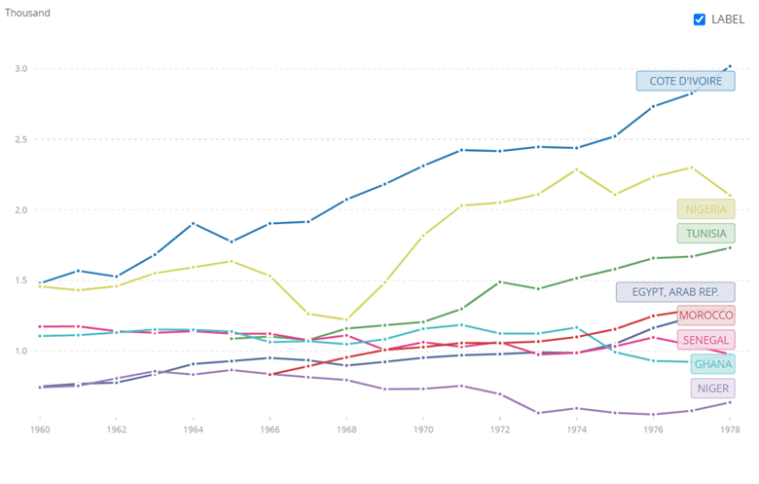
About 40 years ago, there actually was a clear example of a successful African country. Here is GDP per capita in constant 2015 USD from 1960-1978:

Continue reading “Notes on the Ivory Coast”

Notes on Ghana

I spent 12 days in Ghana, specifically in Accra, Kumasi, Cape Coast, and Mole National Park. These are my notes, though this essay is more like Notes on Saudi Arabia with a bigger emphasis on the history of Ghana than my travel experiences.

Ghana has a reputation for being the “easy mode” of West African travel, in contrast to Nigeria being “hard mode.” Ghana speaks English, is a democracy, has been politically stable for 30+ years, has little ethnic tension, low crime, and is one of wealthiest per capita West African states. Altogether, this makes Ghana the (relative) success story of West Africa and I wanted to find out how that happened. A quick rundown of sources:

First, as mentioned in previous essays, Martin Meredith’s Fate of Africa: A History of the Continent Since Independence is an amazing overview, and particularly useful for understanding Ghana’s first prime minister, Kwame Nkrumah.

Second, Jeffrey Herbst’s The Politics of Reform in Ghana, 1982-1991 is a lot less dry than it sounds, and is my main source for Ghana’s second key leader, Jerry Rawlings.

Third, I used a pair of interviews: Jerry Rawlings in 2015 and Corporal Matthew Adabuga in 2018, a former Rawlings bodyguard who wrote a tell-all memoir about Rawlings. Both interviews are fascinating and I highly recommend listening to them if you find the history here interesting, especially since Rawlings’s interview is obviously self-serving, and Adabuga’s claims are suspect, to say the least. Highlights include the (excellent) interviewer asking Adabuga, “do you take delight in killing?” and “why did you kill so many people?,” to which Adabuga responds at one point, “I have never killed anybody physically like that without any cause.”

Other smaller sources: The Legacy of J.J. Rawlings in Ghanaian Politics, 1979-2000, The Rawlings’ Factor in Ghana’s Politics: An Appraisal of Some Secondary and Primary Data, Dead Aid: Why Aid is Not Working and How There Is A Better Way for Africa, a 1985 letter from the Ghana Congress of USA and Canada to the CIA, Ghana’s Foreign Policy Under Jerry Rawlings by Lucy Ansah, Kovsie Journals’s “a comment on frank gerits’ incorrect,” along with various Wikipedia entries and random articles I’ll link directly in the essay when relevant. Continue reading “Notes on Ghana”

Notes on The Gambia

I spent eight days in The Gambia, visiting Banjul, Serrekunda, Georgetown, and driving most of the length of this small country.

Continue reading “Notes on The Gambia”